
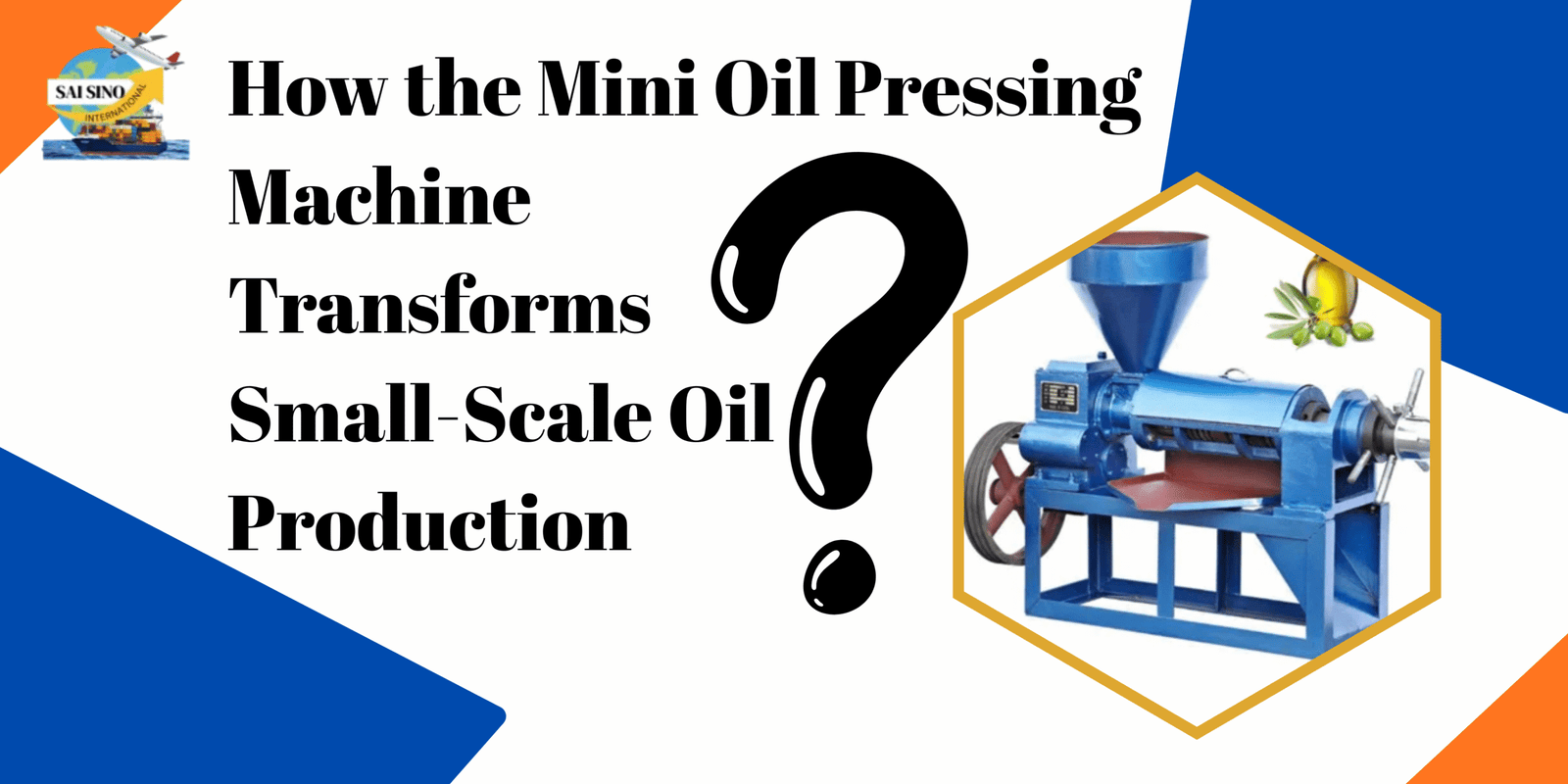
In this day of localized manufacturing and sustainable agriculture, mini oil pressing machines have revolutionized small farmers, cottage industries, and entrepreneurs. Instead of large-scale oil crushing that is expensive and requires significant capital, producers can now use mini presses to produce quality oils on demand from the source of their raw materials.
Why Mini Oil Pressing Matters?
Several areas, especially rural and semi-urban areas, have to rely on large oil mills and long supply chains. This limits margins, increases spoilage, and decreases control over the quality of the oil. A small and efficient oil press:
•Provides vertical integration and the ability to convert raw seed to high-value product at point-of-purchase.
•Allows ability to control quality (cold pressing, low oxidation and purity).
•Lowers Capital and operating costs and a smaller barrier to entry.
•Encourages sustainability and local livelihood – farmers or co-operatives can become micro-processing facilities.
What is a Mini Oil Pressing Machine?
A mini oil pressing machine is a small-scale mechanical device that crushes oil-bearing seeds (i.e., groundnuts, mustard, sesame, sunflower, coconut, etc.) into oil through mechanical pressure, with or without heat. The main components of a mini oil press consist of:
• Feed hopper
• Screw shaft / auger
• Pressing chamber
• Oil outlet & cake outlet
• Motor or power source
• Temperature / control system
• Filters or clarifiers (for finishing the oil)
Mini oil presses may use human power, electricity (small motor), or diesel / small-engine power, depending on the model. The capacity for small presses and mini oil presses is a few kilograms per hour to tens or hundreds of kilograms per hour, depending on the scale.
Typical Specs & Variants
- Capacity: 5–50 kg/h or more
- Power: 0.5 kW to several kW
- Material: stainless steel, food-grade alloys to prevent contamination
- Heating / temperature control: some have adjustable heating zones
- Screw design: single or multi-stage
- Automation / control: manual control or PLC control for larger ones
When you’re choosing a model, you must match capacity to your daily volume, seed type, desired throughput, and power source availability.
Use Cases & Applications
•Farmers and cooperatives: processing their own harvest into branded oil.
•Cottage/local businesses: utilizing gourmet cold-pressed oils for niche markets.
•Demonstration/training: vocational institutions can incorporate into training.
•Rural electrification/micro-industries: in off-grid locales with diesel generators.
For example, a rural farmer producing approximately 100 kg of sesame per week can purchase a mini press to process the seeds and press approximately 15–20 liters of oil onsite to sell local customers rather than transport raw seed to mill located further afield.
Comparing to Traditional Methods
Methods that involve the use of existing ideas (wooden presses, expellers, plants using solvents) typically require more:
•Capital
•Space & infrastructure
•Skilled operators
•Energy or chemicals (in immediate extraction methods with solvents).
However, properly-designed mini presses can achieve modularity, smaller footprint, lower energy use and simplicity. The trade-off is scale- if there is very high volume, you’ll need larger extractors — but for somewhat smaller-segment producers to medium producers, mini presses can hit the sweet spot.
Best Practices in Maintenance and Operation
To extend longevity and remain consistent throughout its life:
1.Food quality: ensure seeds are clean and dry, and remove debris and foreign material.
2.Temperature control: ensure the system does not exceed a certain temperature, even for a short time, as this could mistake something as rancid oil quality.
3.Preheating: in some cases, seeds may benefit from a very gentle preheat.
4.Lubrication: ensure bearings and moving parts remain well-lubricated.
5.Wear parts: replace screws, liners, and bearings that are worn prior to severe damage.
6.Cleaning: periodic deep cleaning to avoid rancidity or contamination.
7.Monitoring: record measuring outputs, yields, energy usage, and troubleshoot anything outside the norm.
If a small machine is well looked after, you can expect it to operate for many years in a reliably consistent way.
Sourcing & Quality Assurance via Sai Sino International
Since its founding in 2006, Sai Sino International has been a full-cycle sourcing and export partner for its customers, from identifying suppliers and exporting containers, to quality inspections, shipping logistics, and much more.
For instance, if a customer wanted to source a mini oil pressing machine:
•They would vet the manufacturers based in China / Hong Kong or related industrial neighborhood
•They would complete quality inspections prior to shipment
•They would facilitate coordinating the container loading / exporting container to India or other global markets
•They have experience using industrial machinery and heavy equipment, customs, compliance, and shipping logistics
Their partnership allows for cross-border procurement with limited risk of receiving faulty goods.
Importing Considerations & Tips
When importing a mini oil pressing machine, you should consider the following items:
•Customs duty / tariffs — check the HS codes for the machines
•Shipping / freight — heavy machines will cost more to ship
•Packaging — make sure a protective crating and moisture barrier is used
•Spare parts — it is a good idea to order spare screws and liners as a measure
•After sales support — supervisor or agent should clarify what support you get
•Standards / certifications — Bilk for food grade stainless, CE and others
Sai Sino’s experience in container shipping and inspecting quality will lessen some of these risks.
Summary & Call to Action
The mini oil pressing machine is an empowering tool for small and medium producers to reclaim value, boost margins, and maintain quality. When utilized safely, responsibly sourced, and with reliable supply chain support (such as from Sai Sino International), it can be a sustainable business resource rather than merely a piece of machinery.